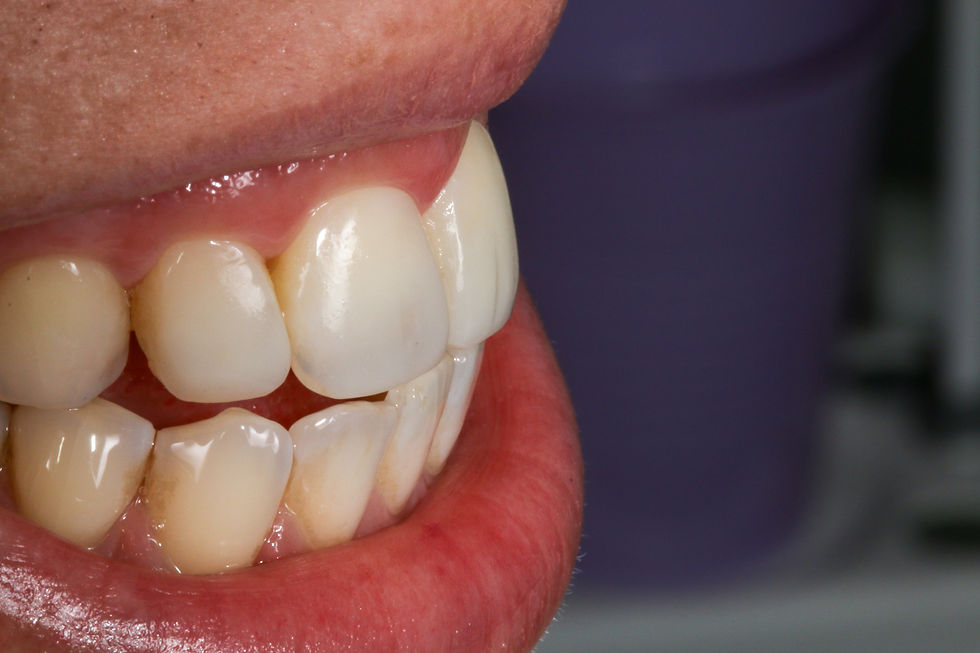
Fixing a Dark Front Tooth with Composite Bonding: A Case Study
Updated: Jun 13
.When one front tooth is noticeably darker than the others, it tends to catch the eye immediately — because the central front teeth sit at the visual center of every smile. A single discolored tooth can make an otherwise healthy smile feel uneven.
This case study from SOL Dental Arts in Maspeth, Queens shows how conservative composite bonding was used to mask a dark central incisor — improving its color while preserving as much natural tooth structure as possible.
Why does one front tooth turn dark?
A single tooth can darken for several reasons — including a past injury to the tooth, aging dental material inside it, or internal changes within the tooth over time. Whatever the cause, the result is the same: a noticeable color mismatch in the most visible part of the smile. Correcting it is usually an elective, cosmetic decision, and the goal is a tooth that blends naturally with its neighbor rather than standing out.
The case: masking a dark central incisor
This patient had a single dark central incisor — a discolored tooth sitting right at the front and center of the smile. They wanted an improvement, but with a conservative approach that did not involve aggressive treatment.
Composite bonding was used to improve the tooth's appearance. In the smile zone, color correction has to be handled carefully: the restored tooth must not look flat, opaque, or artificially bright next to the natural tooth beside it. The objective was a balanced, believable result.
How composite bonding masks a dark tooth
Treating a discolored single tooth at SOL Dental Arts follows a careful sequence:
Evaluation of the single-tooth discoloration — understanding the tooth and how it compares to its neighbors.
A conservative bonding approach to improve appearance — adding composite to mask the discoloration while preserving structure.
Shade and translucency management — layering the material so the tooth has natural depth, not a flat, opaque look.
Finishing to blend with adjacent teeth — refining shape and surface so the tooth matches the smile.
Because this is an additive, minimally invasive approach, it improves the tooth's color while preserving natural tooth structure — and it can often provide a relatively fast esthetic improvement.
When is bonding a good option for a dark tooth?
Composite bonding can be a strong choice when a patient wants to improve a single discolored tooth conservatively and without aggressive treatment. It is not the answer for every case — deeper or more complex discoloration may call for other approaches, such as internal whitening or a veneer. A short evaluation is the best way to confirm which option will give the most natural result for your tooth.
The result
By carefully layering tooth-colored composite and blending it to the surrounding teeth, this case improved the color mismatch in the smile zone while keeping treatment conservative. A well-planned single-tooth bonding case should:
Improve the color mismatch in the smile zone
Preserve natural tooth structure
Support a more balanced, even smile
Provide a relatively fast esthetic improvement
Frequently asked questions
Why does one front tooth get darker than the others?
Discoloration of a single tooth can happen for several reasons, including a previous injury to the tooth, aging dental material, or internal changes within the tooth. The cause is worth identifying as part of the evaluation.
Can bonding cover a dark tooth?
In many cases, yes. Composite bonding can improve the appearance of a discolored tooth while preserving healthy structure — though the right approach always depends on the individual tooth.
Will the color match the other front tooth?
That is the goal. Careful shade selection, layering, and contouring are key to creating a result that blends naturally with the neighboring central incisor.
Is this a conservative treatment?
Yes. Composite bonding is an additive treatment — it builds onto the tooth rather than removing healthy structure — which makes it one of the more conservative ways to address a discolored front tooth.
Bothered by a dark or discolored tooth?
If a single dark tooth is affecting your smile, a conservative fix is often possible. Book an evaluation with SOL Dental Arts in Maspeth, Queens — call (917) 983-4560 — and we will help you find the most natural-looking, tooth-preserving option.
Have a dark or discolored front tooth?
A single discolored tooth can often be camouflaged with composite bonding. When a tooth is very dark, an indirect veneer may be a better color match — here's how to weigh composite bonding vs. porcelain veneers.
Request an appointment → or call (917) 983-4560.
More from SOL Dental Arts: explore related cases — front-tooth reshaping with bonding and a composite veneer for a discolored tooth.