Restoring Fractured Front Teeth with Composite Bonding
Updated: Jun 13
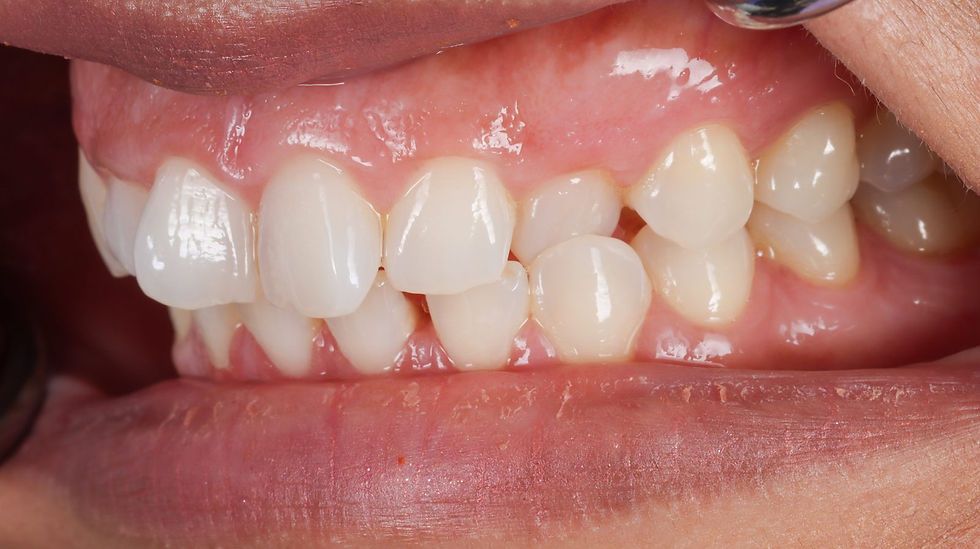
A chip or fracture to a front tooth is one of the most common — and most noticeable — dental injuries. The good news is that many small-to-moderate fractures can be repaired conservatively, without crowns and without drilling away healthy enamel. This patient came in after trauma had broken and shortened an upper central incisor, leaving the two front teeth uneven. Using tooth-colored composite bonding, our team rebuilt the fractured edge and restored a balanced, natural smile in a single visit.
The starting point: a fractured front tooth
Trauma had fractured the inner (mesial) corner of one upper central incisor, leaving it visibly shorter than its neighbor with a rough, slightly stained edge along the break. The asymmetry between the two front teeth was the patient's main concern. The tooth and bite were evaluated first to confirm that a conservative bonding repair was appropriate.
A minimally invasive, same-visit repair
Composite bonding rebuilds a broken tooth by adding tooth-colored resin directly to the remaining tooth — no impressions, no lab, and little to no removal of healthy enamel. Our team shade-matched the resin to the patient's natural tooth color (this was a repair, not a whitening treatment), rebuilt the fractured corner and incisal edge, and refined the shape so the two central incisors matched in length and contour. The work was completed chairside in one visit.
The result
The fractured corner is rebuilt, the two front teeth are even and symmetric again, and the repair blends with the surrounding teeth. The natural shape and the translucency at the edges were preserved so the bonding doesn't stand out.
Holding up over time
Composite bonding is sometimes assumed to be short-lived, so we like to show how it ages. The photo below is the same patient at a follow-up about a year later — the bonded edges are intact and still blending naturally. Like any bonding, it's checked at regular visits, and a tooth that has been through trauma is monitored over time to make sure it stays healthy.
What to know about bonding for chipped or fractured teeth
A few honest notes. Composite bonding is conservative, often reversible, and usually completed in one visit, which makes it a great first option for many chips and fractures. Over time, bonding can chip again or pick up surface stain and may need occasional polishing, repair, or eventual replacement — especially on front teeth that do a lot of biting.
For larger fractures, heavy wear, or when extra strength is needed, porcelain options like veneers or crowns are a longer-lasting (though less reversible) alternative. After dental trauma, the injured tooth is also monitored over time, since some traumatized teeth need further evaluation later. Every case is different and individual results vary — these photos show one patient's outcome.
Related resources for chipped or fractured front teeth
Chipped or broke a front tooth?
If you've chipped, cracked, or broken a tooth — recently or a while ago — our team can walk you through your options, from conservative bonding to longer-lasting restorations, and help you choose what fits.
Related reading: Composite bonding vs. porcelain veneers.