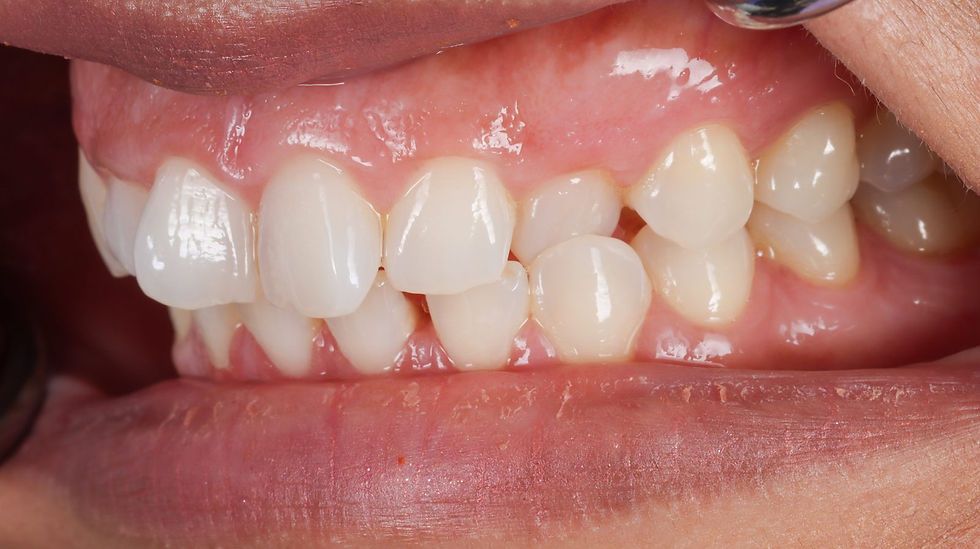
Recreating a Natural Midline Gap with Composite Bonding
Updated: Jun 13
Most cosmetic dentistry around the front teeth is about closing gaps — but not every smile goal points the same way. Some people love the little space between their front teeth and feel it is part of who they are. This patient had her natural midline gap — a diastema — bonded closed years ago, and over time she missed her original smile.
She came in asking us to bring the gap back. Using composite bonding, our team recreated a natural-looking midline diastema in a single visit.
The starting point
Years earlier, the two upper central incisors had been bonded together to close the patient's natural gap. The old bonding had done its job, but it had also picked up some staining along the margins over the years, and — more to the point — it no longer looked like the smile she identified with. She wanted her signature gap back.
A reversible, minimally invasive plan
Composite bonding is just as capable of recreating a gap as it is of closing one. Our team refined the existing bonding and reshaped the inner edges of the two central incisors to reopen a clean, natural-looking midline space, matching the resin to the surrounding tooth color (this was not a whitening treatment).
The approach is additive and conservative — it works with the existing bonding rather than cutting into healthy tooth — and it is adjustable: if she ever changes her mind, the space can be bonded closed again. The work was completed chairside in a single visit.
The result
Her natural midline gap is back, the older staining is gone, and the front teeth have clean, defined edges. More importantly, the smile looks like her again.
About diastemas — and what to expect from bonding
A midline diastema is a normal, common variation, not a flaw, and whether to keep it, close it, or recreate it is entirely a personal esthetic choice — a small gap like this generally is not a functional problem. A few honest notes on composite bonding: like all bonding, it can chip or pick up surface stain over time and may need occasional polishing, repair, or eventual replacement.
The nice part of an additive approach is that it stays adjustable — this gap can be reshaped or re-closed down the road. As with any cosmetic treatment, individual results vary, and these photos show one patient's outcome.
Related resources for tooth gaps and bonding
Want to change — or keep — the gap in your smile?
Whether you would like to close a gap, open one, or simply talk through your options, our team is happy to help you get a smile that feels like you.
Related reading: Composite bonding vs. porcelain veneers.