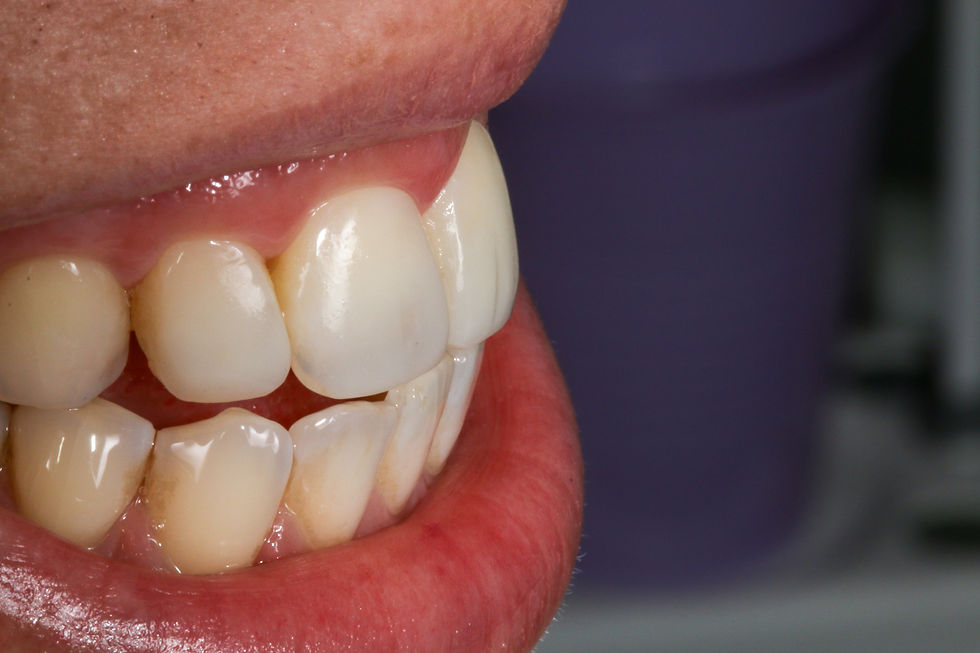
Evening Out Two Front Teeth: Minimally Invasive Bonding for a Balanced Smile
Updated: Jun 13
Not every smile change has to be a big one. This patient liked their smile overall — they just couldn't stop noticing that their two upper front teeth didn't quite match. One sat a little shorter than the other, and because those two teeth sit front and center, the unevenness caught the eye every time they smiled. They weren't after a dramatic makeover, just a more even, balanced look.
We were able to get there with a single, conservative step: minimally invasive composite bonding on one front tooth to bring it into harmony with its neighbor.
The starting point
The two teeth at the center of the smile are the upper central incisors. Here, they were slightly mismatched: one central incisor sat a touch shorter, with a worn and slightly uneven biting edge, while the tooth beside it was a little longer and fuller.
On its own the difference was subtle — but symmetry is a big part of what makes a smile feel balanced, so even a small mismatch between the two most prominent teeth can make a smile look uneven. That difference in shape, not the color or health of the teeth, was the patient's concern.
A minimally invasive plan
We chose direct composite bonding — adding tooth-colored resin to the edge of the shorter tooth and sculpting it by hand to match its neighbor. It's an additive, minimally invasive approach: little to no natural tooth structure is removed, there's no drilling into healthy enamel, and the whole thing is completed in a single visit.
For a situation like this — where the goal is to refine the shape and length of one tooth rather than reshape the entire smile — composite bonding is often the most conservative way to even things out. And because it adds to the tooth rather than cutting it down, it keeps future options open.
The result
With a small, carefully shaped addition of composite, the two central incisors now read as a matched pair — even in length, with balanced edges and a harmonious midline. In everyday smiling and talking, the smile looks more symmetrical and settled, without looking "done." We matched the natural translucency and shade of the surrounding teeth, so the bonded edge blends in rather than standing out. You can see more of our before-and-afters in our smile gallery.
What composite bonding is — and caring for it
Composite bonding is a durable, conservative restoration, but it isn't indestructible. Over time, composite can chip, wear, or pick up surface stain, and it may need occasional polishing, a small repair, or eventual replacement — like any tooth-colored material in a working mouth. Day-to-day care is simple: brush and floss as usual, and try not to use your front teeth as tools (opening packages, biting nails or pens).
If there's any grinding or clenching, a nightguard is worth discussing, since that's hard on both natural teeth and bonding.
To be clear about what this case did and didn't involve: this was a change in shape only. No whitening was performed and the tooth shade was not altered — any difference in brightness between the photos reflects lighting, not a whitening result. Every smile is different, and the result shown reflects one patient's treatment; it isn't a promise of what any individual will experience.
Common questions about bonding for uneven front teeth
Can composite bonding fix uneven front teeth?
Often, yes. When one front tooth is shorter, worn, or slightly misshapen, a thin layer of tooth-colored composite can be added and sculpted to match the neighboring tooth — evening out the length and edges without removing healthy tooth structure. Whether bonding is the right choice depends on the specific teeth and your bite, which we'd check at a visit.
Is bonding or a veneer better for one uneven tooth?
Both can work, with different trade-offs. Composite bonding is additive, usually needs little or no tooth reduction, and is typically completed in one visit. A porcelain veneer is a custom, lab-made facing that's very stain-resistant and long-lasting, but it usually involves some tooth preparation and more than one visit. For a single tooth that mainly needs a small shape change, bonding is often the more conservative place to start.
How long does composite bonding last?
With good care, composite bonding commonly lasts several years, though it isn't permanent — it can chip, wear, or pick up surface stain over time and may need occasional polishing, a small repair, or eventual replacement. Avoiding habits like biting nails, and wearing a nightguard if you grind, both help it last.
Could a small change even out your smile?
If one tooth has always looked a little out of step with the rest, a conservative option like composite bonding may be all it takes — and it's worth a conversation before anything more involved. Our team at SOL Dental Arts in Maspeth, Queens would be glad to take a look and walk you through your options.
Related reading: composite bonding, improving front-tooth symmetry, and how long composite bonding lasts.
More from SOL Dental Arts: explore related cases — front-tooth reshaping with bonding and a composite veneer for a discolored tooth.
Related reading: Composite bonding vs. porcelain veneers.